A roofing company transformed from manual operations into a fully automated, connected business.
A roofing company transformed from manual operations into one fully automated, connected business.
A high-volume Perth roofing company managing hundreds of property maintenance jobs for property managers and homeowners, using employees and subcontractors.
As the business grew, administration became increasingly manual across scheduling, workorders, rostering, safety, reporting, invoicing and client communication.
Jobs were manually scheduled through Google Sheets, with staff reviewing locations, availability and workloads to build daily runs.
Workorders were opened and entered manually. Workers were rostered by hand, while confirmations, reminders and job updates required constant administration.
Safety documents, job photos and completion requirements also had to be manually monitored.
After every attendance, office staff used the worker’s findings and photos to manually create leak reports and repair recommendations before jobs could move to invoicing.
More jobs meant more admin, more double handling and more opportunities for errors.
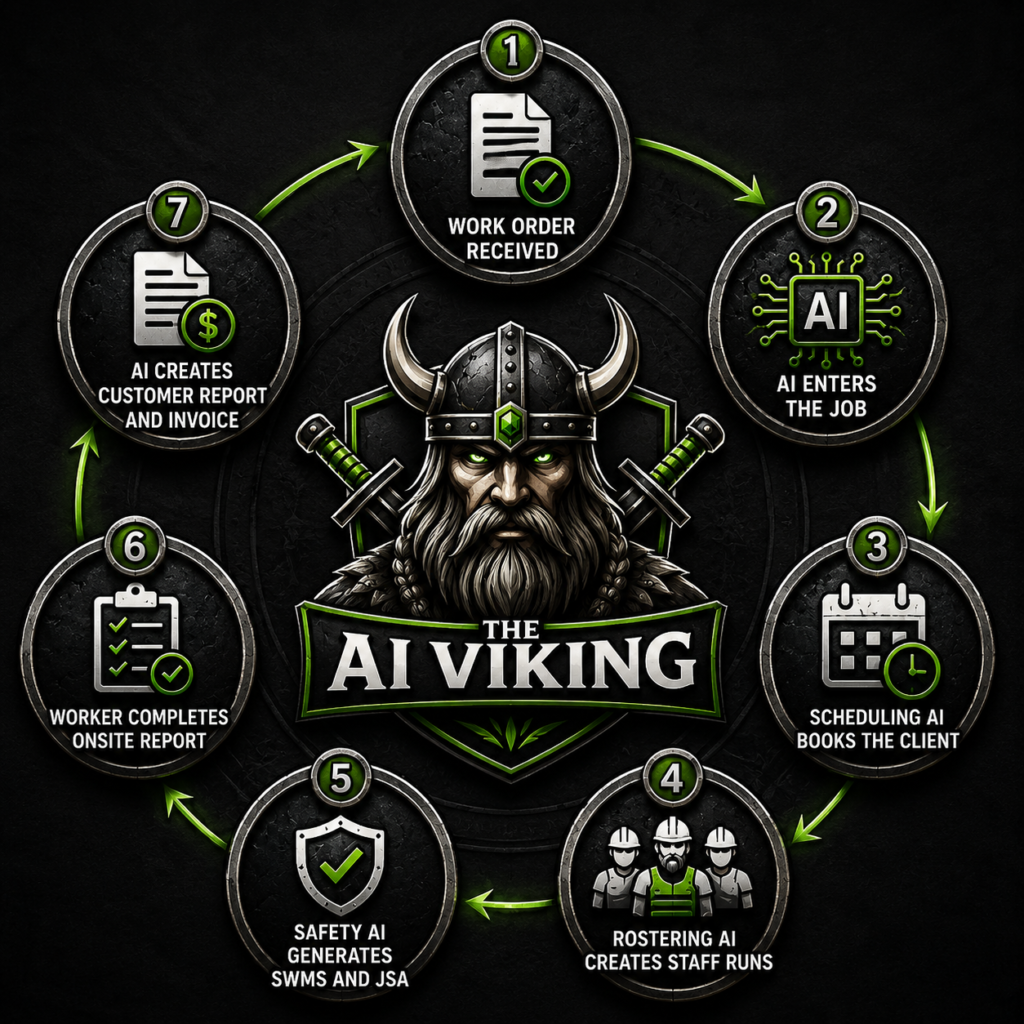
We built a connected automation system covering the entire job lifecycle.
Incoming workorders and enquiries are automatically read and entered into the system.
Jobs flow through scheduling, booking and rostering, with workers receiving organised daily runs and everything required onsite.
Customer confirmations, reminders and job updates are automatically sent.
Workers access job details, safety requirements, JSAs, forms and organised photo folders directly from each job.
Submitted field information automatically generates professional leak reports and repair recommendations.
Completed jobs, reports, photos, safety information, contractor workflows and invoicing all remain connected within the same system.
What was once a collection of Google Sheets, manual data entry and disconnected processes is now one connected operational system.
The office has live visibility, workers have everything they need onsite, clients are automatically kept informed and completed jobs move through the business with far less manual handling.
Less administration. Less double handling. Faster processing. More capacity to grow.
A high-volume Perth roofing company managing hundreds of property maintenance jobs for property managers and homeowners, using employees and subcontractors.
As the business grew, administration became increasingly manual across scheduling, workorders, rostering, safety, reporting, invoicing and client communication.
Jobs were manually scheduled through Google Sheets, with staff reviewing locations, availability and workloads to build daily runs.
Workorders were opened and entered manually. Workers were rostered by hand, while confirmations, reminders and job updates required constant administration.
Safety documents, job photos and completion requirements also had to be manually monitored.
After every attendance, office staff used the worker’s findings and photos to manually create leak reports and repair recommendations before jobs could move to invoicing.
More jobs meant more admin, more double handling and more opportunities for errors.
We built a connected automation system covering the entire job lifecycle.
Incoming workorders and enquiries are automatically read and entered into the system.
Customer confirmations, reminders and job updates are automatically sent.
Workers access job details, safety requirements, JSAs, forms and organised photo folders directly from each job.
Submitted field information automatically generates professional leak reports and repair recommendations.
Completed jobs, reports, photos, safety information, contractor workflows and invoicing all remain connected within the same system.
What was once a collection of Google Sheets, manual data entry and disconnected processes is now one connected operational system.
The office has live visibility, workers have everything they need onsite, clients are automatically kept informed and completed jobs move through the business with far less manual handling.
Less administration. Less double handling. Faster processing. More capacity to grow.
The choice is yours.