Every AI Viking system is supported by clear documentation outlining how your automations, platforms, workflows and data connect across your business. It provides a central reference for understanding, maintaining and evolving your system as your business grows.
Every AI Viking system is supported by clear documentation outlining how your automations, platforms, workflows and data connect across your business. It provides a central reference for understanding, maintaining and evolving your system as your business grows.
Every AI Viking system is built as part of a connected business infrastructure, not as a collection of isolated automations.
Our documentation provides a clear reference for how each system operates, what platforms it depends on, how information moves through the business and how the system is maintained as the business evolves.
Each AI Viking build is designed around the individual business and its existing operational processes.
Depending on the project, a system may connect areas such as:
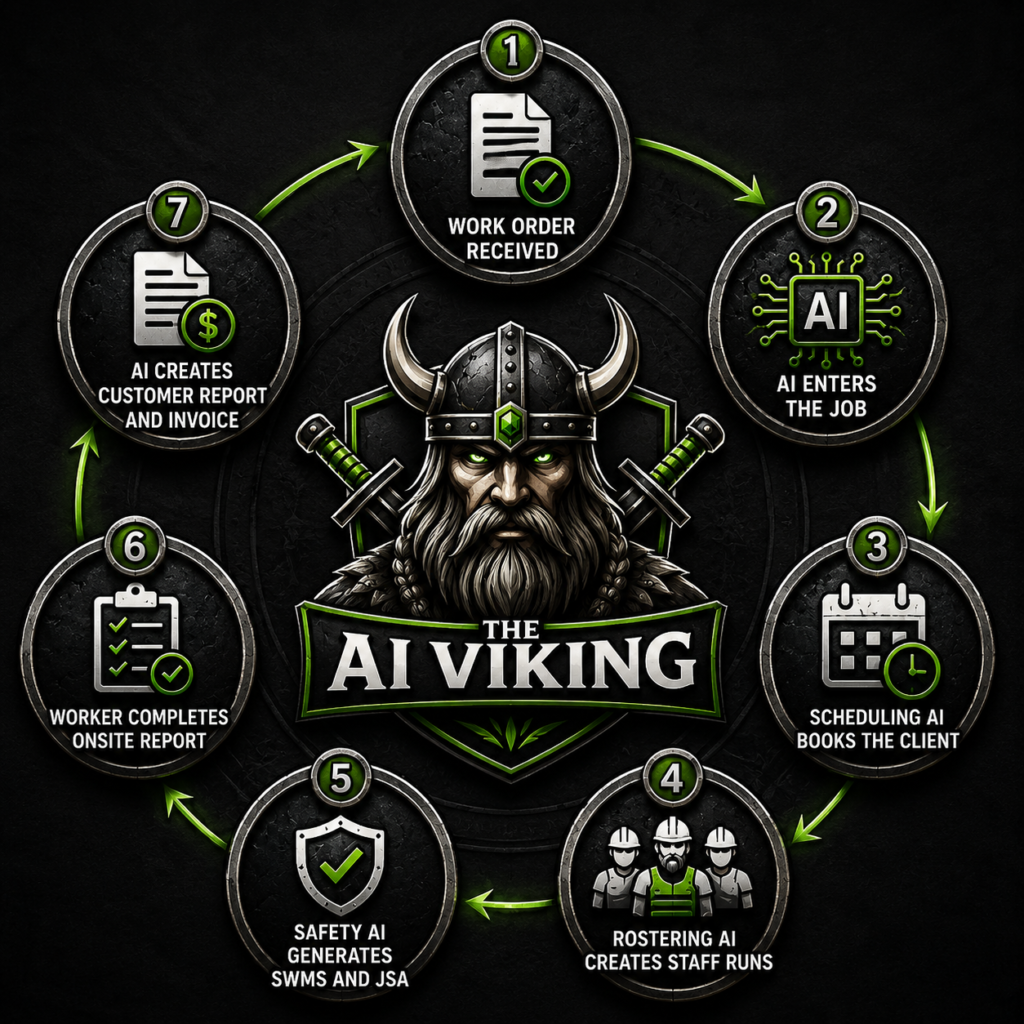
Enquiries and workorders
Customer and job information
Scheduling and bookings
Employee and contractor rostering
Customer communication
Safety and compliance
Field reporting
Photos and documentation
Quoting and invoicing
Payments
Management reporting
AI processing
The objective is to create a connected operational system where information can move between different parts of the business without unnecessary manual handling.
AI Viking systems may connect multiple third-party platforms, databases, communication services and AI providers.
Rather than requiring staff to repeatedly transfer information between these platforms, automations are used to control how information moves through the system.
Where appropriate, a central operational database or platform may act as the primary source of information for jobs, customers, workers and workflow status.
Individual system architecture varies depending on the client’s requirements and the technology being used.
Major automations within a client system may be documented to provide a clear understanding of their purpose and operation.
Documentation may identify:
what triggers the automation;
what information it receives;
what process it performs;
which platforms it communicates with;
what information it creates or updates;
the expected outcome; and
relevant dependencies or failure conditions.
This provides a reference for maintaining, troubleshooting and expanding the system.
AI Viking systems may integrate with third-party platforms already used by the client or platforms introduced as part of the project.
These may include:
automation platforms;
databases;
email providers;
SMS and communication services;
accounting software;
scheduling and rostering platforms;
cloud storage;
electronic signature services;
artificial intelligence providers;
customer management systems; and
other business software.
Third-party services remain subject to their own terms, pricing, availability, functionality and technical limitations.
Documentation may identify how important business information moves through the system.
For example, information may enter through an enquiry, email, form or workorder before being processed and transferred into other parts of the business.
This may include customer information, job details, booking information, worker updates, reports, photographs, invoices or other operational information.
The purpose of documenting these flows is to provide visibility over where information originates, where it is processed and where it is ultimately stored or used.
Where artificial intelligence forms part of a system, its role is defined according to the requirements of the workflow.
AI may be used for tasks such as:
reading emails and documents;
extracting information;
categorising enquiries;
interpreting workorders;
generating reports;
summarising information;
preparing communications; or
assisting with administrative processing.
Not every process requires AI.
Where a task can be completed more reliably through structured rules or conventional automation, those methods may be used instead.
Access to systems should be provided according to the responsibilities of each user.
Different access levels may be established for:
business owners;
managers;
administration staff;
employees;
field workers;
contractors; and
other authorised users.
Clients are responsible for advising AI Viking when users should be added, removed or have their permissions changed unless user administration forms part of an ongoing service agreement.
AI Viking systems are designed with reasonable consideration for access control and information security.
Depending on the platforms involved, this may include individual user accounts, authentication controls, permissions and restricted access to sensitive areas of the system.
Passwords, API credentials, authentication tokens and other sensitive technical information are not included in public system documentation.
Clients should maintain appropriate password security and immediately remove access for users who no longer require it.
Automated systems depend on the continued operation of the platforms and services they connect to.
A workflow may rely on multiple external services operating correctly for the complete process to function.
Changes made by third-party providers, including API changes, service outages, authentication changes, feature changes or discontinued functionality, may affect connected automations.
Where this occurs, modifications may be required to restore or alter the affected workflow.
Where appropriate, systems may include processes designed to identify failed or incomplete automation activity.
Depending on the workflow, this may include:
error notifications;
failed-job monitoring;
status flags;
retry processes; or
manual review requirements.
Automation reduces manual administration but does not eliminate the possibility of software errors, third-party outages, incorrect source information or unexpected system behaviour.
Critical business processes should retain appropriate human oversight.
New systems and significant changes should be tested before being introduced into normal business operations.
Testing may include sample records, test communications, workflow validation and confirmation that information is moving between connected platforms as intended.
Because automated systems interact with third-party software and real-world business information, it may not be possible to replicate every possible scenario during testing.
Systems may therefore continue to be refined following deployment.
Automation systems are built around defined business processes.
If a client changes the way their business operates, this may affect existing automations.
Clients should advise AI Viking before making significant changes to connected platforms, workflows, forms, fields, email structures, user permissions or other processes relied upon by the system.
A change that appears minor in one part of a business may affect multiple connected workflows.
Systems may require maintenance as businesses, software platforms and operational requirements change.
Depending on the client’s agreement, support may include:
troubleshooting;
automation monitoring;
minor adjustments;
platform updates;
workflow maintenance; and
technical assistance.
New features, significant workflow changes, additional integrations or substantial system modifications may be treated as new development rather than maintenance.
The applicable scope is determined by the client’s service or support agreement.
Clients remain responsible for the operation of their business and for ensuring the information entered into their systems is accurate.
Clients are also responsible for maintaining required third-party accounts and subscriptions, managing authorised users, protecting login credentials and advising AI Viking of significant changes that may affect the system.
Automated outputs should be reviewed where they affect important financial, legal, safety, employment or operational decisions.
Data storage and backup arrangements depend on the platforms used within each system.
Many third-party platforms maintain their own infrastructure, backup and recovery procedures.
AI Viking does not represent that every piece of information processed through an automation can always be recovered following deletion, corruption, platform failure or third-party service interruption.
Businesses should maintain appropriate independent records and backups for information considered critical to their operations.
Client business data remains the client’s information, subject to the terms of the applicable service agreement and third-party platforms used.
AI Viking may retain ownership of its underlying methodologies, frameworks, automation architecture, reusable components, prompts, processes, templates, system designs and other intellectual property used to develop or operate a solution.
Specific ownership, licensing and access arrangements may be further defined within the client’s service agreement.
As a system develops, documentation may be updated to reflect significant changes to workflows, integrations or system functionality.
Not every minor adjustment will necessarily result in an immediate documentation update.
Where detailed system documentation is provided to a client, it should be treated as a reference to the system at the time the documentation was prepared or most recently updated.
For security and intellectual property reasons, client-facing or public documentation does not necessarily contain every technical detail of an AI Viking system.
Information that may be excluded includes:
passwords and credentials;
API keys;
authentication tokens;
webhook addresses;
proprietary prompts;
detailed automation logic;
internal development methods;
security configurations; and
reusable AI Viking intellectual property.
This information may be maintained separately where required for system operation and support.
Business automation is not static.
Businesses change, employees change, software changes and new opportunities for automation emerge.
AI Viking systems are therefore designed as operational infrastructure that can be maintained, refined and expanded as the business develops.
System documentation provides the reference point that helps keep that infrastructure understandable, maintainable and connected as it grows.
Every AI Viking system is built as part of a connected business infrastructure, not as a collection of isolated automations.
Our documentation provides a clear reference for how each system operates, what platforms it depends on, how information moves through the business and how the system is maintained as the business evolves.
Each AI Viking build is designed around the individual business and its existing operational processes.
Depending on the project, a system may connect areas such as:
Enquiries and workorders
Customer and job information
Scheduling and bookings
Employee and contractor rostering
Customer communication
Safety and compliance
Field reporting
Photos and documentation
Quoting and invoicing
Payments
Management reporting
AI processing
The objective is to create a connected operational system where information can move between different parts of the business without unnecessary manual handling.
AI Viking systems may connect multiple third-party platforms, databases, communication services and AI providers.
Rather than requiring staff to repeatedly transfer information between these platforms, automations are used to control how information moves through the system.
Where appropriate, a central operational database or platform may act as the primary source of information for jobs, customers, workers and workflow status.
Individual system architecture varies depending on the client’s requirements and the technology being used.
Major automations within a client system may be documented to provide a clear understanding of their purpose and operation.
Documentation may identify:
what triggers the automation;
what information it receives;
what process it performs;
which platforms it communicates with;
what information it creates or updates;
the expected outcome; and
relevant dependencies or failure conditions.
This provides a reference for maintaining, troubleshooting and expanding the system.
AI Viking systems may integrate with third-party platforms already used by the client or platforms introduced as part of the project.
These may include:
automation platforms;
databases;
email providers;
SMS and communication services;
accounting software;
scheduling and rostering platforms;
cloud storage;
electronic signature services;
artificial intelligence providers;
customer management systems; and
other business software.
Third-party services remain subject to their own terms, pricing, availability, functionality and technical limitations.
Documentation may identify how important business information moves through the system.
For example, information may enter through an enquiry, email, form or workorder before being processed and transferred into other parts of the business.
This may include customer information, job details, booking information, worker updates, reports, photographs, invoices or other operational information.
The purpose of documenting these flows is to provide visibility over where information originates, where it is processed and where it is ultimately stored or used.
Where artificial intelligence forms part of a system, its role is defined according to the requirements of the workflow.
AI may be used for tasks such as:
reading emails and documents;
extracting information;
categorising enquiries;
interpreting workorders;
generating reports;
summarising information;
preparing communications; or
assisting with administrative processing.
Not every process requires AI.
Where a task can be completed more reliably through structured rules or conventional automation, those methods may be used instead.
Access to systems should be provided according to the responsibilities of each user.
Different access levels may be established for:
business owners;
managers;
administration staff;
employees;
field workers;
contractors; and
other authorised users.
Clients are responsible for advising AI Viking when users should be added, removed or have their permissions changed unless user administration forms part of an ongoing service agreement.
AI Viking systems are designed with reasonable consideration for access control and information security.
Depending on the platforms involved, this may include individual user accounts, authentication controls, permissions and restricted access to sensitive areas of the system.
Passwords, API credentials, authentication tokens and other sensitive technical information are not included in public system documentation.
Clients should maintain appropriate password security and immediately remove access for users who no longer require it.
Automated systems depend on the continued operation of the platforms and services they connect to.
A workflow may rely on multiple external services operating correctly for the complete process to function.
Changes made by third-party providers, including API changes, service outages, authentication changes, feature changes or discontinued functionality, may affect connected automations.
Where this occurs, modifications may be required to restore or alter the affected workflow.
Where appropriate, systems may include processes designed to identify failed or incomplete automation activity.
Depending on the workflow, this may include:
error notifications;
failed-job monitoring;
status flags;
retry processes; or
manual review requirements.
Automation reduces manual administration but does not eliminate the possibility of software errors, third-party outages, incorrect source information or unexpected system behaviour.
Critical business processes should retain appropriate human oversight.
New systems and significant changes should be tested before being introduced into normal business operations.
Testing may include sample records, test communications, workflow validation and confirmation that information is moving between connected platforms as intended.
Because automated systems interact with third-party software and real-world business information, it may not be possible to replicate every possible scenario during testing.
Systems may therefore continue to be refined following deployment.
Automation systems are built around defined business processes.
If a client changes the way their business operates, this may affect existing automations.
Clients should advise AI Viking before making significant changes to connected platforms, workflows, forms, fields, email structures, user permissions or other processes relied upon by the system.
A change that appears minor in one part of a business may affect multiple connected workflows.
Systems may require maintenance as businesses, software platforms and operational requirements change.
Depending on the client’s agreement, support may include:
troubleshooting;
automation monitoring;
minor adjustments;
platform updates;
workflow maintenance; and
technical assistance.
New features, significant workflow changes, additional integrations or substantial system modifications may be treated as new development rather than maintenance.
The applicable scope is determined by the client’s service or support agreement.
Clients remain responsible for the operation of their business and for ensuring the information entered into their systems is accurate.
Clients are also responsible for maintaining required third-party accounts and subscriptions, managing authorised users, protecting login credentials and advising AI Viking of significant changes that may affect the system.
Automated outputs should be reviewed where they affect important financial, legal, safety, employment or operational decisions.
Data storage and backup arrangements depend on the platforms used within each system.
Many third-party platforms maintain their own infrastructure, backup and recovery procedures.
AI Viking does not represent that every piece of information processed through an automation can always be recovered following deletion, corruption, platform failure or third-party service interruption.
Businesses should maintain appropriate independent records and backups for information considered critical to their operations.
Client business data remains the client’s information, subject to the terms of the applicable service agreement and third-party platforms used.
AI Viking may retain ownership of its underlying methodologies, frameworks, automation architecture, reusable components, prompts, processes, templates, system designs and other intellectual property used to develop or operate a solution.
Specific ownership, licensing and access arrangements may be further defined within the client’s service agreement.
As a system develops, documentation may be updated to reflect significant changes to workflows, integrations or system functionality.
Not every minor adjustment will necessarily result in an immediate documentation update.
Where detailed system documentation is provided to a client, it should be treated as a reference to the system at the time the documentation was prepared or most recently updated.
For security and intellectual property reasons, client-facing or public documentation does not necessarily contain every technical detail of an AI Viking system.
Information that may be excluded includes:
passwords and credentials;
API keys;
authentication tokens;
webhook addresses;
proprietary prompts;
detailed automation logic;
internal development methods;
security configurations; and
reusable AI Viking intellectual property.
This information may be maintained separately where required for system operation and support.
Business automation is not static.
Businesses change, employees change, software changes and new opportunities for automation emerge.
AI Viking systems are therefore designed as operational infrastructure that can be maintained, refined and expanded as the business develops.
System documentation provides the reference point that helps keep that infrastructure understandable, maintainable and connected as it grows.
The choice is yours.